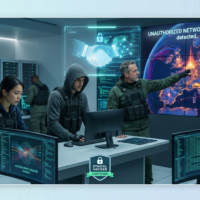

🛡 Zero Trust Networks
Why modern organizations no longer trust users, devices, or networks by default.
🏰 The Old Castle Model
For years organizations built security like castles.
Strong walls.
Strong gates.
Strong defenses.
Once inside the castle:
You were trusted.
🏰 Traditional Security Model
⬇️
🔥 Firewall
⬇️
🏢 Internal Network
⬇️
✅ Trusted Users
⚠ The Problem
What happens if:
- A device is compromised?
- Credentials are stolen?
- An attacker gains internal access?
In traditional environments:
The attacker may inherit trust.
🤔 What Is Zero Trust?
Zero Trust is a security model based on one principle:
Always Verify.
Every request must be validated.
Every device must be verified.
Every user must be authenticated.
🛡 Zero Trust Model
⬇️ Verify 📱 Device
⬇️ Verify 🔐 Identity
⬇️ Verify 📋 Policy
⬇️ Allow 🖥 Application
🔑 Multi-Factor Authentication (MFA)
One of the most visible Zero Trust controls is MFA.
Instead of relying only on a password:
- Password
- Authenticator App
- Hardware Key
- Biometric Verification
Multiple verification methods improve security.
💻 Device Verification
Modern systems may check:
- Operating System Version
- Disk Encryption Status
- Endpoint Protection
- Patch Level
A valid user on an unhealthy device may still be denied access.
🎫 Least Privilege Access
Users should receive:
Only the access they need.
Not every system.
Not every application.
Not every database.
Only what is required for their role.
🌍 Where You’ll See Zero Trust
- Microsoft Entra ID
- Google Workspace
- Cloud Environments
- Corporate VPN Replacements
- Enterprise SaaS Platforms
Many modern organizations are actively adopting Zero Trust principles.
🧰 Technologies Commonly Used
- Multi-Factor Authentication
- Single Sign-On (SSO)
- Identity Providers
- Conditional Access Policies
- Endpoint Management Platforms
These technologies help enforce Zero Trust decisions.
🚨 Real Scenario
An employee logs in from:
- New country
- Unknown device
- Unusual time
Traditional security:
✅ Access Granted
Zero Trust:
🔍 Additional verification required
🧠 Security Architect Challenge
An employee only needs:
- HR Portal
- Project Management Tool
Should they automatically access:
- Databases?
- Server Management Consoles?
- Cloud Infrastructure?
Zero Trust says:
No.
🏆 Key Lesson
Modern cybersecurity assumes compromise is possible.
Instead of trusting everything inside the network:
Every request is continuously evaluated.
Trust becomes something that is earned and verified—not assumed.
🏰 How Enterprise Networks Are Protected
The grand finale. Combine everything you’ve learned and step inside a modern enterprise network architecture used by large organizations.


Recent Comments