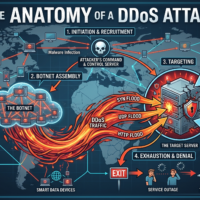

🎬 The Attack Begins
It’s 2:14 PM.
An online retailer is processing thousands of orders every minute.
Everything looks normal.
Then traffic suddenly jumps.
10,000 requests per second.
50,000 requests per second.
200,000 requests per second.
Within minutes customers cannot access the website.
The security team receives alerts.
A DDoS attack has started.
⚡ How a DDoS Attack Works
🦠 Infection
Devices become compromised
🤖 Botnet
Thousands join together
📡 Command
Instructions are sent
🔥 Target
Traffic flood begins
🤖 What Is a Botnet?
A botnet is a collection of devices controlled remotely.
Attackers don’t usually generate all attack traffic themselves.
Instead they leverage thousands of compromised systems simultaneously.
Common Botnet Devices
- 📷 Security Cameras
- 📡 Routers
- 📺 Smart TVs
- 💻 Computers
- 📱 Mobile Devices
- ☁️ Cloud Servers
🎯 Three Main Types of DDoS Attacks
🌊 Volumetric
Overwhelms bandwidth with massive amounts of traffic.
⚙️ Protocol
Consumes server and network resources.
🌐 Application Layer
Targets websites, APIs, and web applications.
⏳ Attack Timeline
T-30 Days
Devices become compromised.
T-7 Days
Botnet grows in size.
T-1 Hour
Target selected.
T+0
Attack begins.
T+15 Minutes
Services start failing.
T+1 Hour
Incident response team engages.
📊 Why DDoS Attacks Matter
Minutes
to impact services
Millions
of requests per second
Global
business disruption
🛡 Defender Mindset
When investigating a potential DDoS attack, ask:
- Where is the traffic coming from?
- Is the traffic legitimate?
- Which service is under pressure?
- Can traffic be filtered safely?
- Is the attack targeting bandwidth or applications?
🤖 Deep Learning Prompt
NEXT CHAPTER
The Biggest DDoS Attacks in History
Explore the attacks that disrupted governments, financial institutions, cloud providers, and some of the largest websites on the internet.


Recent Comments